
LUCY PURRINGTON


MOTHER - WORKING TITLE
STARTING POINT: grief. mother. where is my mother tongue. a scream.
I saw my mother in the wind blowing through a tree outside her house the evening of her death.
When the tree was in blossom, she used to stare out the kitchen window at it.
She shouted at children who were trying to snap its branches once.
I hear a scream in my mind.
What will happen if I release it and scream outside?
Do I keep it inside, what will happen if I externalise it? Am I scared to move on and firstly address the loss. Or scared am I that nothing will change.
You have to resurrect the deep pain within you and give it a place to live that’s not within your body.
Let it live in art.
Let it live in writing.
Let it live in music.
Let it be devoured by building brighter connections. Your body is not a coffin for pain to be buried in.
Put it somewhere else ...
- Ehime Ora
THE SCREAM
I can't actualise my scream, so I found it in music, in media.



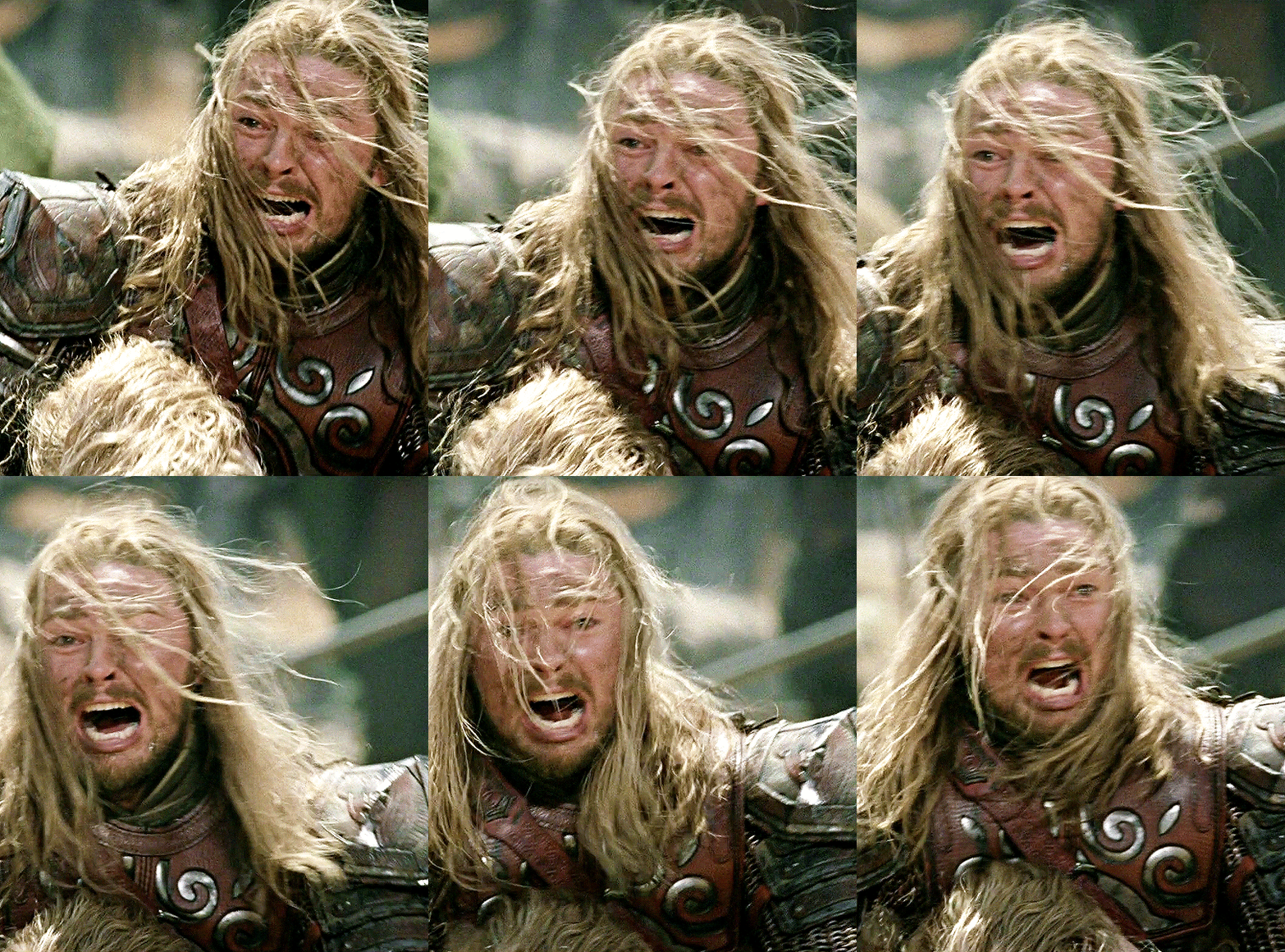


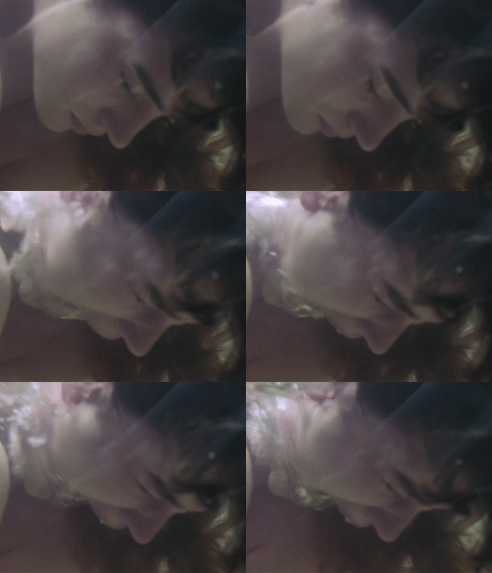


Unable to scream, I felt it haunt my body. It burned in my arms, in my chest, my throat closed. I looked to movement, to my body. To the ways my body was holding my grief, the aches, the tension and muscle knots.
https://stiftung-imai.de/videos/katalog/medium/1840
Ulrike Rosenbach - Einwicklung mit Julia
Feminist Avant-Garde of the 1970's, Works from the Verbund Collection
The Photographer's Gallery London
7th October 2016 - 15th January 2017
The exploration of an individual trauma was felt collectively by women and mother's in a decade where the feminist movement questioned the individual sense of self and the affliction of being caught between two opposing dogmatic ideals under the role of mother.
The landscape was changing in terms of the stereotyping of female roles within society, but the domestic role of mother and the accompanying guilt wielding voice of the previous generation prevailed over the birth of feminist rhetoric at that time. In this video piece there is a conflicting personal desire for wanting different for the child away from the constrictive culture the mother figure grew up in against the pressures of sticking to the social norm.
Although the video depicts the act of societal submission of the domestic mother told performatively through meticulously chest bind herself to the daughter figure, the piece informs the viewer of the deliberate performance of submission. And so the piece becomes a piercing statement of the violence of her motherly shackles.
The performance of repeatedly wrapping bandages around the chest area also signifies the hiddeness of female flesh and its eroticism. The culturally sexualised breasts are another symbol of femininity and the knowing that one is being watched as a female performer, she watches herself being surveyed and acts accordingly. Understanding that it is her performance and not a subconscious performativity brings to our attention the difficulties of being an individual as a female if she always knows that she is being surveyed.
The binding itself would not be physically painful, yet it's visual metaphor for the entrapment of binding oneself to the societal expectations of western society.
When looking at formative art work, you can't help but create comparisons from then to now. The fracture not of the burden of motherhood but instead the burden of the expectation of the mother is still a topic for discussion in our modern culture. But it is this reflective comparison that causes injury to me; to think that so much has changed since then, but the world that we live in now has its own insidious constraints. We're bound to a hypersexualised culture where women are criticised, objectified and tied to a new set of ridiculous restraints that govern our mind and body. The statistics are there from a range of mental health and cosmetic surgery procedures that an emergence of new controlling parameters - the beauty myth.
Sound of the breathing. inhale, exhale. passing on time.


Framing my understanding of grief in a wider sense in my community: Senghenydd disaster.
Grief in a wider context of growing up in the Aber valley.
Growing up, learning about the horrors of the disasters as a young child and the stories of the headed man, the dog that waited, the survivor who slept late.
Generational trauma and feeling of loss. Community spirit. post-memory, epigenetics. > how is this trauma passed on to the current generation?
Grief of the land, the remnants of the mines: scarred. Regrowth, grass and houses replace the mine.


How does an entire community mourn.
> Mourning clothes at St Fagans. BELOW>
*Noticed they were from someone living in Abertridwr.


My loss is not just my own.
My grief makes me wonder how the Aber Valley survived such a huge collective grief.
What about Wales' grief.
The people lost, the land lost, the pillaging for wealth, our language and love.
The howling, stinging wind quietens my mind and feelings.
All I feel is the wind, she embraces me. I am together again, I am whole with the land.
Mae'r gwynt udo, pigo yn tawelu fy meddwl a'm teimladau. Y cyfan rwy'n ei deimlo yw'r gwynt, mae hi'n fy nghofleidio. Rwyf gyda'n gilydd eto, rwy'n gyfan gyda'r tir.
The starting point was the grief I live within for my mother. Carrying the weight of this, I was sensitive to other feelings of mourning: growing up in the Aber Valley, the loss endured in the Senghenydd disaster has permeated through the generations, it's part of the subconscious culture, my mother tongue, a sense of what it is to be within Cymru.
Grief is cold. A damp cold. That gets into your bones. That’s why I feel it more keenly in the colder months.
It would have been her birthday in late December.
As I write these thoughts, they feel clumsy. Somehow unnatural.
Gweldais i hi yn y goeden yn y gwynt.
Nothing I make means anything,
and it won't.
Not until I realise and release this.
And scream.
I need to make something. But I can't see what yet. Pointing my camera, hoping to capture somethignt that means, something.
horrible stillness
saw horrible faces in the yellow walls
I hate this sickly yellow colour
yellow
sickness
Life went on around us.
Nothing stopped to hear or witness our grief.
The everyday sounds. Became empty.